By: Nour Halabi
International humanitarian law is only as strong as the willingness to uphold it.
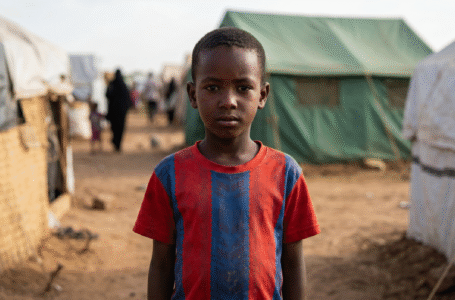
Since March 2026, 4,328 Lebanese people have been killed, 12,224 injured, and more than one million displaced. Around 135 paramedics have been killed, along with 21 journalists.
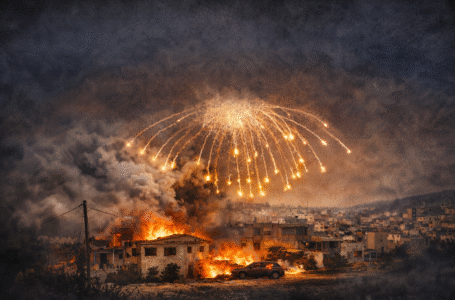
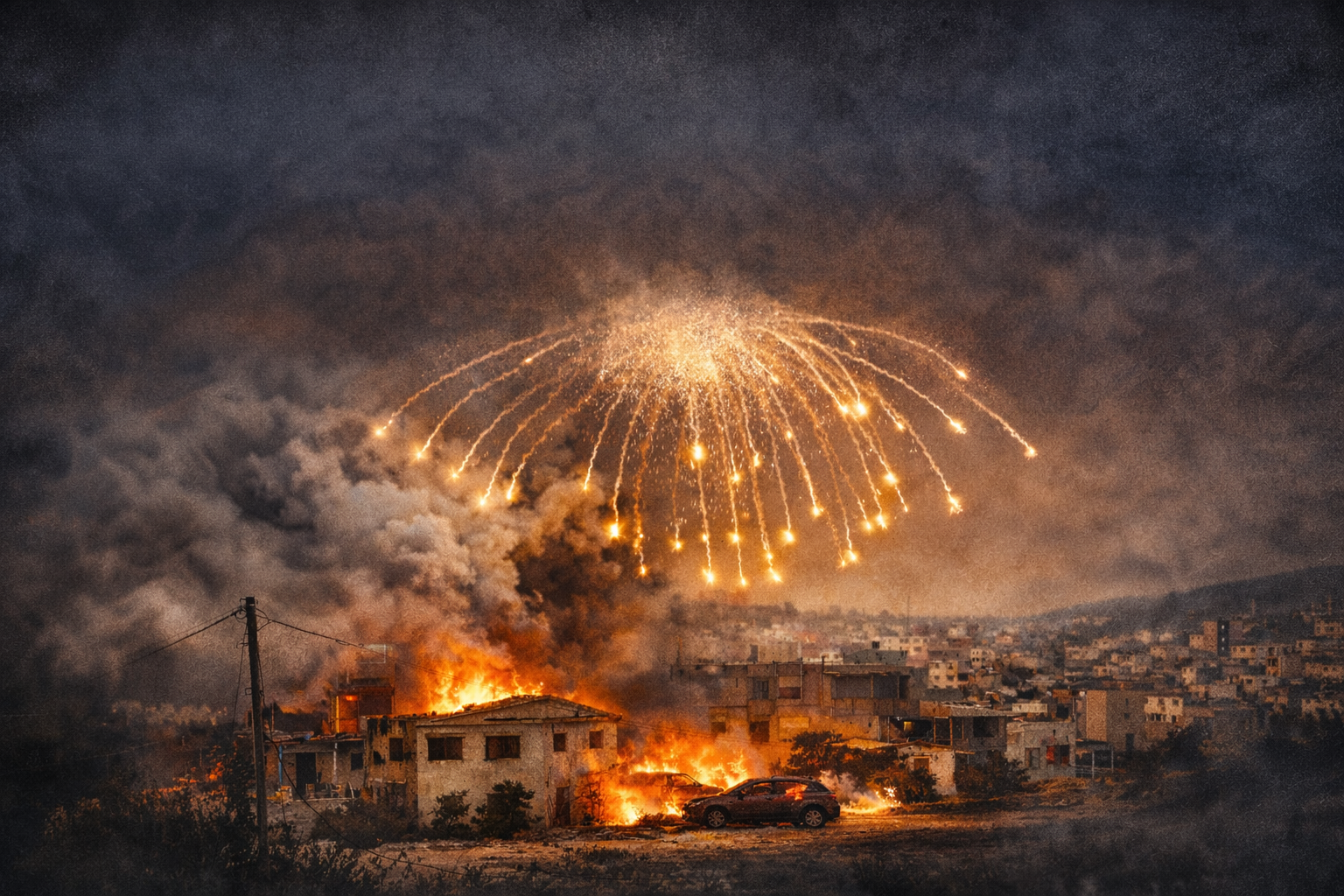
Among the most shocking tactics documented in Lebanon are double-tap strikes: a military tactic in which a target is struck once, then hit again minutes later. The second strike often lands as rescuers, journalists, or others arrive to help. It can involve two airstrikes, or a combination of an airstrike and a drone attack.
International humanitarian law (IHL) exists for one purpose: to protect those who are not taking part in hostilities and those who risk their lives to save others. The Geneva Conventions and their Additional Protocols provide special protections for civilians, medical personnel, humanitarian workers, and journalists. When attacks purposefully target those protections, they may amount to serious violations of IHL as well as war crimes.
Thus, this piece focuses on why double-tap strikes are not merely another military tactic, but a practice that raises profound legal and humanitarian concerns under international law.
The Law Double-Tap Strikes Defy
Evidently, the Geneva Conventions came out of the atrocities of war. They were created to ensure that even in conflict, there are limits to human suffering. Yet decades later, those same atrocities remain extremely prominent. Thus, what exactly does international humanitarian law require?
The four Geneva Conventions provide a comprehensive legal framework for protecting people affected by armed conflict:
- The First Geneva Convention protects wounded and sick members of armed forces and medical personnel on the battlefield.
- The Second extends similar protections to those wounded, sick, or shipwrecked at sea.
- The Third establishes protections for prisoners of war.
- The Fourth emphasizes the protection of civilians during wartime, including those living under occupation.
- Their Additional Protocols further develop these protections, especially by strengthening safeguards for civilians and regulating the conduct of hostilities.
Among these protections, the status of medical personnel is explicitly recognised. Geneva Convention I, Article 24, states plainly that medical personnel exclusively engaged in the search for, collection, transport, or treatment of the wounded and sick “shall be respected and protected in all circumstances.”
Beyond these specific protections, all attacks under IHL must comply with three principles: distinction, proportionality, and precautions in attack. Distinction requires attacking forces to separate combatants from civilians and target only the former. Proportionality prohibits an attack where expected civilian harm would be excessive relative to any anticipated military advantage. The obligation to take precautions requires parties to do everything feasible to avoid or minimise civilian harm.
These principles assume a single moment of decision: a target is identified, assessed, and struck. A double-tap strike breaks that assumption.
The second strike is not aimed at the original military objective; it is aimed at whoever the first strike draws in – paramedics, family members, and neighbors. That population is, by definition, foreseeable.
Therefore, legal experts and human rights organisations have raised serious concerns about double-tap strikes, arguing that their pattern of targeting those who respond to an initial attack may constitute breaches of IHL and war crimes.
Six Faces of the Second Strike
The legal framework regarding double-tap strikes is clear. The next question is why they occur at all: what purpose does striking a target twice serve?
The following functions identify recurring consequences and possible purposes that investigators should examine when assessing the timing, targets, and circumstances of a second attack. A single strike may also serve several of these functions simultaneously.
Erasing the Crime Scene
Journalists and first responders are naturally the first people positioned to document a strike. Hence, killing them in a second attack also tends to eliminate whoever might have gathered evidence of the first one.
Evidence is the enemy. Those carrying out these attacks know that their conduct may amount to war crimes and serious violations of IHL. We live in an age in which evidence is everywhere: on mobile phones, social media, live broadcasts and online archives. Images, videos, eyewitness accounts and testimonies can circulate within minutes and remain accessible long after an attack.
Hence, a second strike may serve to erase what the first one left behind. It can destroy the physical scene, kill witnesses and journalists, damage cameras and phones, and prevent rescuers or investigators from safely reaching the area.
In this sense, the attack targets the evidence needed to prove the crime.
For instance, reporting on the Nasser Hospital strike noted that the attack was captured live on broadcast television only because a crew happened to already be filming when the second strike hit. In most cases, no such record survives.
Silencing the Witnesses
Journalists perform a clear and crucial role during war: they document attacks, identify victims, challenge official accounts, and preserve evidence that may later be used in investigations.
Under Additional Protocol I, article 79, journalists carrying out dangerous professional assignments in conflict areas are considered civilians and must be protected as such, provided they do not take actions that adversely affect their civilian status.
In Lebanon alone, at least 21 journalists have been killed since the war began.
The recent killing of Lebanese journalist Amal Khalil illustrates why double-tap strikes raise such serious concerns for press freedom and accountability.
On April 22, 2026, Khalil and photojournalist Zeinab Faraj were reporting in al-Tayri in southern Lebanon following an earlier Israeli strike on a vehicle. After another strike occurred nearby, the two journalists sought shelter inside a house. The house was subsequently struck, killing Khalil and seriously wounding Faraj. Rescue efforts were reportedly delayed for hours because emergency workers came under fire. Lebanese officials described the incident as a double-tap strike.
The silencing effect also extends beyond the journalist who is killed. When reporters know that arriving at the scene of an initial attack may expose them to a second strike, they may hesitate to approach, remain at a greater distance, or abandon coverage entirely.
Silencing journalists can therefore also silence victims, conceal patterns of abuse, and significantly weaken the possibility of future accountability and transitional justice.
Killing Those Who Come to Save
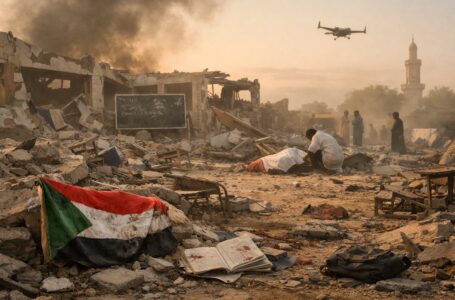
A double-tap strike may weaponize the predictable humanitarian response to the initial attack. Paramedics and rescue workers are drawn to the location because people have been wounded and require urgent assistance. When the scene is struck again after their arrival, the act of providing medical care becomes a source of danger.
Attacks on ambulances and emergency teams may discourage other medical workers from approaching future strike sites, delay treatment, as well as increase the likelihood that people injured in the first attack will die from otherwise treatable wounds.
Among the most scrutinized cases is the January 2024 killing of five-year-old Hind Rajab and two Red Crescent paramedics who were killed by tank fire while attempting to reach her. An analysis by the campaign group Avaaz concluded there is substantial evidence the ambulance strike was a deliberately timed second attack on medical responders, and the group is pushing the ICC to investigate.
That same tactic has since recurred throughout Israel’s campaign in Lebanon. Human Rights Watch found apparent war crimes in three October 2024 attacks alone, including a strike on Salah Ghandour Hospital in the southern Lebanese town of Bint Jbeil.
In addition, in April, a series of strikes on the village of Mayfadoun killed four paramedics in what some outlets called a “triple-tap attack.” And on May 22, a second strike hit paramedics responding to an earlier strike near Deir Qanoun al-Naher, killing at least seven, including 3 paramedics and photojournalist Ahmad al-Hariri.
Execution Without Trial
The first strike may wound or incapacitate its original target without killing them. A second strike makes sure that the person does not survive.
IHL does not automatically protect every fighter merely because they have suffered an injury. Nonetheless, a person who is unconscious, has surrendered, is detained or has become physically incapable of defending themselves may be considered “hors de combat.” A person who is recognised as hors de combat may not be made the object of attack.
In other words, where the attacker knows, or should reasonably know, that the person can no longer fight, a follow-up strike may amount to the unlawful killing of a protected person.
Punishing Resistance, Targeting Communities
While the relationship between resistance, occupation, and IHL is politically contested, the main legal rule remains clear: parties must distinguish between lawful military targets and the wider civilian population. Additional Protocol I recognises certain armed conflicts in which peoples fight against alien occupation in exercising their right to self-determination.
An attacking force cannot treat entire communities as military targets because of their political alignments, sect, family relationships, geographical location or assumed association with an armed movement. Civilians do not lose protection merely because they support resistance politically, live in an area associated with it or assist their communities in ways that do not amount to direct participation in hostilities.
Thus, a double-tap strike may function as a form of punishment directed at the relatives, neighbors, rescuers, and community members who gather after the initial attack. When civilians are harmed because of acts they did not personally commit, the attack may also raise concerns regarding collective punishment and intimidation, both prohibited under the Fourth Geneva Convention.
No political label can erase the obligation to distinguish a lawful military objective from the surrounding civilian community.
Terror as a Method of War
Lastly, double-tap strikes affect more people than those directly killed or injured. By attacking the same location after paramedics, journalists, relatives and nearby residents have arrived, they create the expectation that anyone approaching a strike site may also become a target.
When such attacks are repeated, the fear they create may spread far beyond the immediate location. Entire communities may begin avoiding damaged areas, delaying medical assistance or leaving their homes because they believe that an initial strike is merely the beginning of a wider attack. Therefore, this tactic may help empty areas of their population, isolate the wounded, and undermine the systems of mutual support on which civilians depend during war.
IHL specifically prohibits acts or threats of violence whose primary purpose is to spread terror among the civilian population. Fear alone does not prove this legal threshold has been met, but when second strikes follow a timed, repeated pattern that seems designed to deter rescue, documentation, or civilian presence, investigators must consider whether the tactic is being used to terrorise communities.
Overall, taken together, these functions reveal that double-tap strikes are not random: whatever the goal may be, each strike systematically and purposefully undermines the very protections IHL was designed to guarantee.
While the violations are blatant, impunity reigns. What, then, have domestic and international actors done about it?
The Architecture of Impunity
On June 26, 2026, after rounds of direct talks with an entity that the Lebanese Constitution recognises as an enemy, a framework was born. Known as the Lebanon-Israel Framework Agreement, it consists of 14 points. Overall, it recognises Israel’s right to exist, lacks any meaningful accountability framework, does not require Israel to withdraw from Lebanese territory, and legitimizes the pilot zones Israel has established and taken over in Lebanon.
In other words, this framework offers neither accountability nor justice for the Lebanese people. Instead, it shields Israel from responsibility. What it does not shield the Lebanese people from is double-tap strikes.
Of course, none of this happens in a vacuum. Lebanon has not acceded to the Rome Statute, which leaves the International Criminal Court (ICC) without automatic jurisdiction over crimes committed on its own soil–a gap Amnesty International and other rights groups have repeatedly urged Beirut to close, calls the Lebanese government has yet to act on.
The Lebanese government has tied its fate to a framework that is clearly advantageous to Israel. It has not acceded to the Rome Statute, and it has relied on a so-called ceasefire and a UNSCR 1701 implementation process that Israel has violated on a near-daily basis with zero consequence.
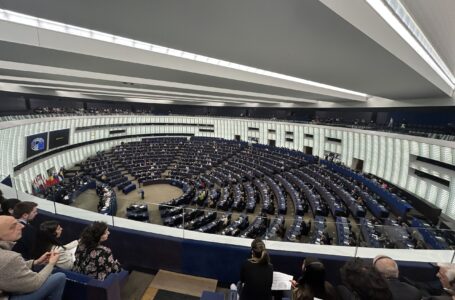
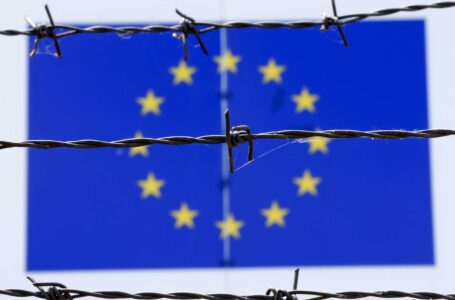
Additionally, the response from the wider international community has followed a familiar script: statements of concern, not enforcement. The European Union has repeatedly “condemned” and expressed being “deeply troubled” by strikes on Lebanon. Its foreign policy chief Kaja Kallas has said Israel’s “right to defend itself does not justify inflicting such massive destruction” – language not strong enough to move policy.
The EU’s failure is not merely rhetorical. It is a failure to enforce its own legal standard. Article 2 of the EU-Israel Association Agreement makes respect for human rights and democratic principles an “essential element” of the relationship, and a violation of that clause legally entitles the EU to suspend the agreement.
On May 20, 2025, the EU’s High Representative announced a formal review of Israel’s compliance with Article 2. That review reportedly found Israel in breach of the clause the following month. And yet, over a year later, no qualified majority has been reached in the Council to suspend so much as the agreement’s trade provisions, despite repeated calls from member states, MEPs, and dozens of civil society organizations.
More than ninety rights groups have warned that this inaction “risks rendering the Association Agreement’s human rights clause meaningless in practice.” One EU legal commentary went further, calling the entire review “a performative act void of any substance.”
Lebanon defers, the EU condemns, and Israel continues.
In brief, the law exists. Double-tap strikes are in violation of it. Nevertheless, they persist because all entities with the power to enforce the law have, so far, chosen not to raise a finger.